Inasport
Inasport
Inasport, as a major port city, has a unique political landscape shaped by its strategic location, economic importance, and diverse population. The city's politics are heavily influenced by both domestic concerns and international trade relations, making it a hub of economic activity and political maneuvering.
Merchant Elite and Trade Interests: A significant portion of Inasport's political power lies in the hands of the merchant elite, who control the city’s bustling docks and trade routes. These wealthy traders are often deeply involved in city politics, lobbying for policies that benefit the free flow of goods, low tariffs, and favorable relationships with neighboring countries. Many of the city's key political decisions are made with the goal of preserving its status as a prime trade hub.
Port Authority and Governance: The Port Authority plays a central role in Inasport's political structure, managing both the infrastructure of the harbor and the regulations that govern shipping, customs, and port services. The Authority is often seen as a de facto governing body, with significant influence over the city’s budget and development plans. In some cases, the city’s political leadership may be a representative of the Port Authority or someone closely aligned with the interests of the trading community.
Powerful Guilds and Workers: While the merchants hold economic power, various guilds represent workers in Inasport, ranging from dockworkers to shipbuilders and artisans. These guilds have considerable influence, and their support is essential for any politician seeking office. They advocate for workers' rights, better working conditions, and protection from exploitation by the wealthy merchant class. Tensions between the merchant elite and these guilds are common, often erupting in protests or strikes, which can impact the city’s economy.
International Diplomacy and Rivalries: Inasport is constantly balancing its political relationships with neighboring cities and countries. As a port city, it relies on trade agreements, treaties, and diplomacy to secure its position. The city often serves as a neutral ground for political negotiations or as a battleground for international rivalries, where different factions vie for control of lucrative trade routes or influence over local politics.
Corruption and Political Maneuvering: Due to its wealth and importance, Inasport's politics are often marred by corruption and under-the-table deals. Politicians, especially those connected to the merchant class or port authorities, may be seen as prioritizing personal gain over the well-being of the city's people. As a result, reformist movements and calls for transparency regularly surface, though they often struggle against entrenched interests.
Diversity and Social Tensions: With a large influx of foreign traders, sailors, and workers from various regions, Inasport is a melting pot of cultures, languages, and religions. This diversity often leads to social tensions, with different communities competing for influence and resources. Political factions may form along ethnic or social lines, with some groups advocating for greater representation or rights, while others push for policies that favor economic stability and security over social integration.
Overall, Inasport’s political system is a delicate balance of trade-driven interests, powerful guilds, international diplomacy, and the constant push and pull between different social and economic classes. It’s a city where wealth and power are closely intertwined, but also a place where the undercurrents of class struggle and political intrigue shape the daily lives of its citizens.
The Cityscape of Inasport
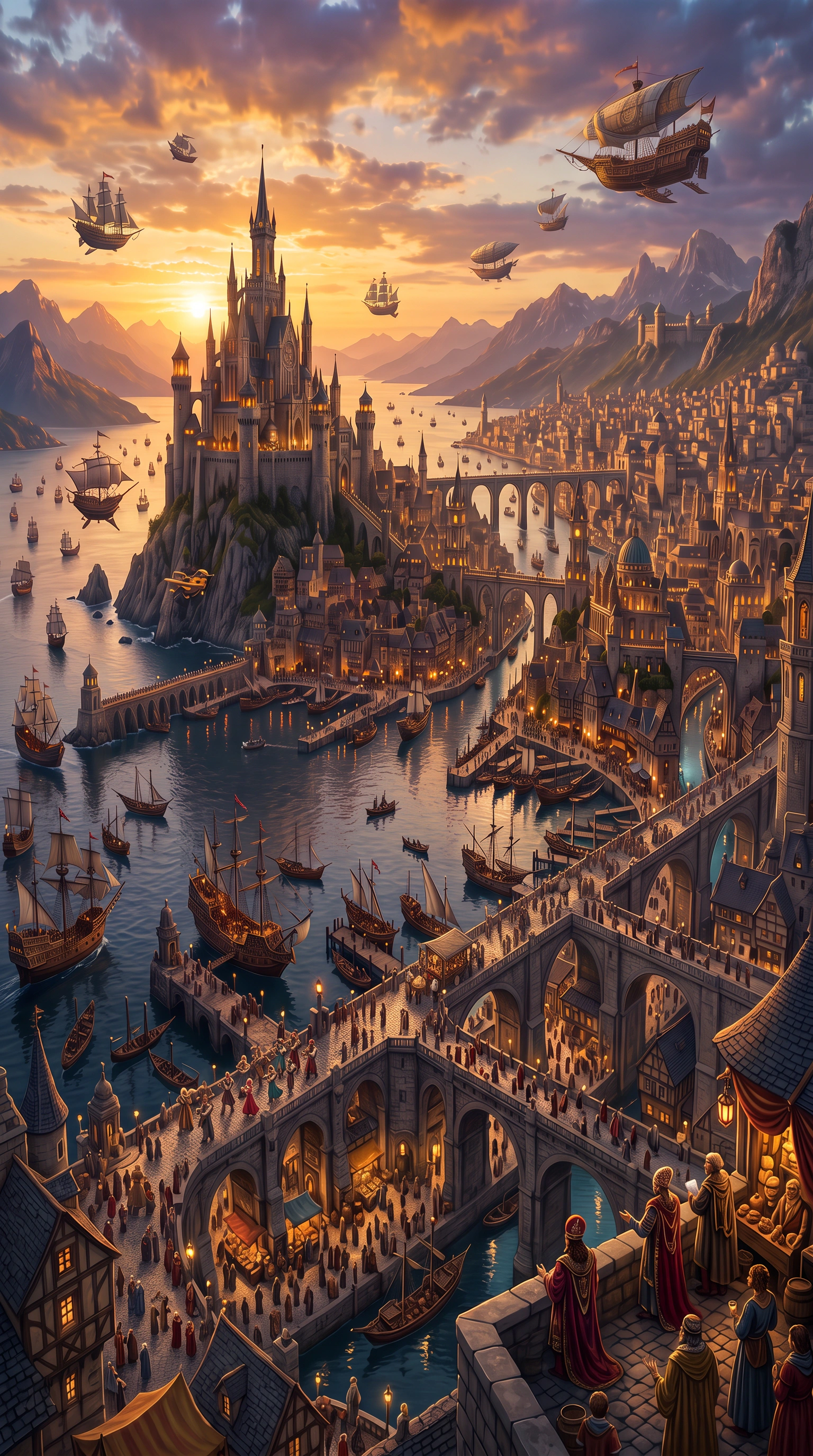
Inasport is an expansive coastal city, built along a series of rugged cliffs and natural harbors. Its geography and architecture reflect its identity as a bustling, international port city at the crossroads of trade and culture.
Harbor District
At the heart of Inasport is its enormous Harbor District, the lifeblood of the city. The harbor itself is a sprawling network of docks, piers, and warehouses. Ships of all sizes—from small fishing boats to grand merchant vessels—crowd the docks, constantly unloading goods from distant lands. The air is thick with the smells of saltwater, fish, and exotic spices, and the cacophony of voices from sailors, traders, and dockworkers fills the atmosphere.
Along the waterfront, you’ll find towering warehouses that store goods ranging from textiles to precious metals. These buildings are often interconnected by a series of narrow alleyways, where small shops and taverns cater to the transient nature of the seafaring population. The Customs House, a grand building made of dark stone, sits near the docks, where ships’ cargo is inspected and taxed. It’s a place of power, often under scrutiny due to its association with corrupt dealings and backroom negotiations.
The Merchant Quarter
A short walk away from the bustling harbor, the Merchant Quarter is a district of opulence. Narrow cobblestone streets wind through rows of lavish townhouses, high-end trading posts, and gilded storefronts. Here, the wealth generated from global trade flows into grand estates, where the city’s merchant elite live in luxury. This district is also home to the Mercantile Guildhall, a massive stone structure where influential traders gather to discuss matters of commerce, politics, and power. The streets are filled with rich merchants, foreign dignitaries, and well-dressed courtiers, often seen making deals or attending high-society balls.
Large, open-air markets in this district sell exotic goods such as fine silk, rare spices, and crafted items brought from faraway lands. Wealthy buyers can be seen negotiating fiercely for luxury items, while those who can’t afford them watch from the sidelines. The Royal Exchange, a large building with a dome and ornate columns, serves as the center for financial transactions, with deals being made in gold and precious stones. The influence of the Merchant Quarter extends beyond its walls, with merchants funding political campaigns or using their wealth to sway decisions in the city’s governance.
The Inner City and Government
Beyond the Merchant Quarter lies the Inner City, the political and cultural heart of Inasport. This area is home to grand administrative buildings and the Council Hall, where city leaders and politicians convene to make decisions. The architecture is a mix of styles, reflecting the diverse cultures that have passed through the city over centuries—Elven arches, dwarven stonework, and human columns create a stunning patchwork of history.
The Governor’s Palace, a massive stone structure with towering spires and lush gardens, sits in the heart of the Inner City. The Governor, who holds considerable influence but is often swayed by the Port Authority and merchant guilds, resides here. The palace is frequently a site of political intrigue and conspiracies, as factions vie for power behind its walls.
Adjacent to the palace is The Forum, a public space where citizens, workers, and politicians engage in heated debates. This is the site of protests and gatherings, as the lower classes demand reforms or rally for causes like workers’ rights or better living conditions.
The Dockside Slums
To the west of the Harbor District lies the Dockside Slums, a squalid and overcrowded area where many of the city’s poor and transient population live. The slums are a maze of narrow streets, ramshackle buildings, and poorly maintained homes. This area is largely controlled by various criminal organizations, who profit off the influx of sailors, travelers, and dock workers. Smugglers and pirates frequent the slums, as the city’s control weakens in the face of poverty and corruption.
Life in the slums is harsh, with many living in near-constant poverty, working long hours on the docks or in the warehouses for meager pay. Crime is rampant, and law enforcement is either nonexistent or easily bribed. The lower classes are often at odds with the wealthier citizens, leading to social unrest and tension. The Underport, a series of tunnels and hidden passageways beneath the city, serves as a haven for criminals, dissidents, and those seeking to escape the watchful eyes of the city authorities.
The Outskirts and Farmland
Outside the city’s walls lies the fertile land that feeds Inasport’s population. Small farming communities grow crops that are transported into the city for sale in the markets. The Greenfields are well-tended by peasants and farmers, who are mostly left to their own devices by the government but are still under the thumb of wealthy landowners. While these outskirts provide much-needed resources, they also represent a simmering tension, as many of the lower classes feel exploited by the merchant elite and government officials who benefit from their labor.
The Politics of Inasport
Inasport's political structure is complex, shaped by the interests of various factions. The Port Authority is the most powerful body, holding sway over the economy, infrastructure, and trade policies. Many members of the City Council are aligned with powerful merchant families, and much of the legislation passed favors their interests—lower taxes on trade goods, tax breaks for certain industries, and minimal regulation.
At the same time, there are political factions pushing for reform, especially among the workers' guilds and the poorer populations in the slums. Leaders from these groups often clash with the merchant elite and government officials. Tensions come to a head at times, especially when workers demand better wages or living conditions. Labor strikes are not uncommon, and the city’s political scene can erupt into chaos when protests turn violent.
Cultural Influence
Inasport’s port status has attracted a diverse array of people from all over the world. The city is a melting pot of cultures, religions, and traditions. There are sections of the city where foreign communities—such as the East Asian, Northern Nomads, or Middle Eastern—have set up their own quarters. This diversity creates a unique social fabric, with cultural festivals, exotic foods, and a vibrant mix of languages spoken in the streets.
However, this diversity also brings friction, as ethnic or cultural minorities sometimes face discrimination, and political factions may form along cultural lines. Foreign merchants and sailors can often be seen as outsiders, even though they play an integral part in the city’s economy.
The Underworld
The criminal element in Inasport is as vibrant as its legitimate business. In the Dockside Slums, rival gangs fight for control of trade routes, smuggling rings, and black-market goods. Many of these criminals have powerful allies within the city’s elite, creating an atmosphere of corruption and backroom deals. The Underport, a series of hidden tunnels beneath the city, acts as a shadowy network for illicit activities, from drug smuggling to human trafficking.
Inasport’s Future
Inasport’s future is a precarious one. The tension between the ruling merchant class and the working poor continues to rise, while the city’s reliance on foreign trade makes it vulnerable to external political forces. The city’s position as a cultural and economic crossroads gives it a unique power, but it also makes it a target for those seeking to influence or control the wealth that flows through its docks.
The delicate balance of power between the elite, the government, the guilds, and the working class will likely determine whether Inasport continues to thrive or descends into further turmoil.